

Claim Your Free Consultation
Speak directly with our skin cancer team, who will assess and advise based on your condition and physiology in a free, 10 minute consultation.
EXPERT SKIN CANCER TEAM
Advanced Skin Cancer Removal & Reconstruction
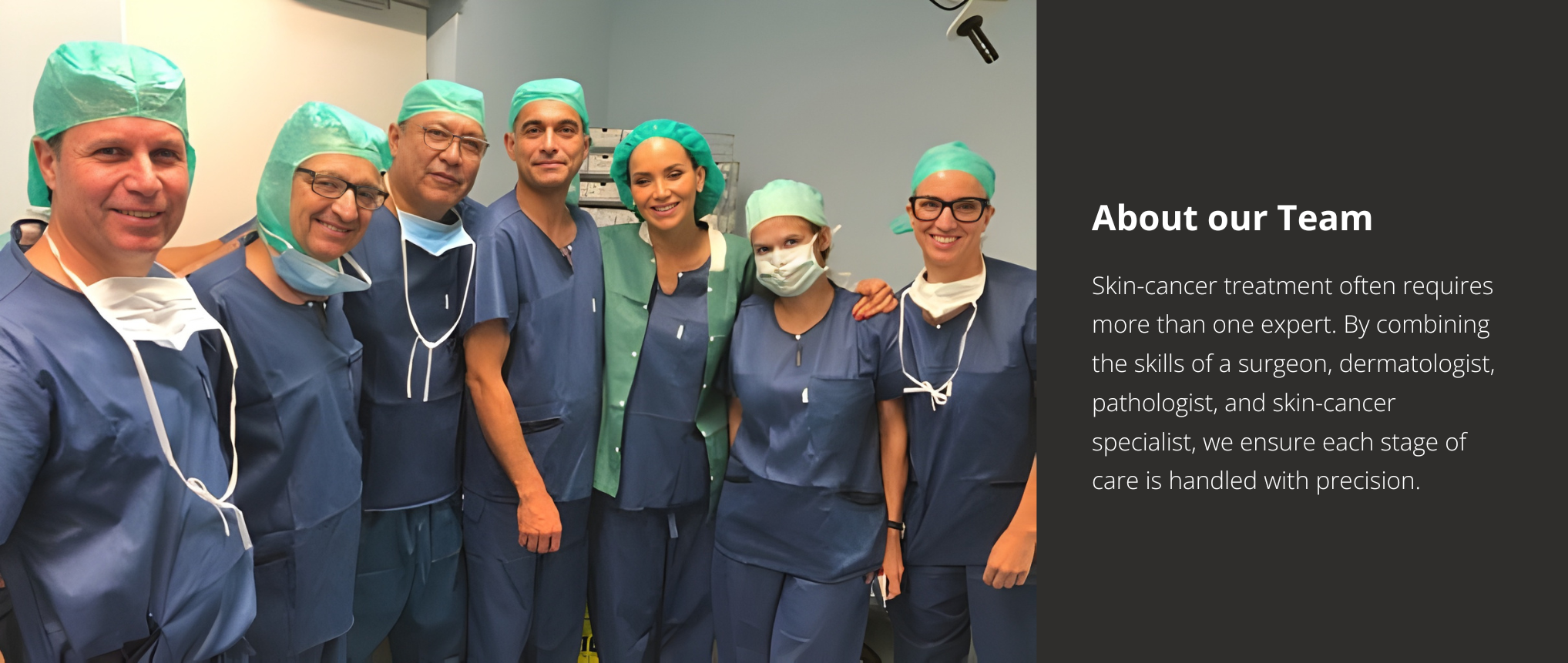
When facing a skin-cancer diagnosis, you deserve care from a multidisciplinary team that brings precision, experience, and compassion to every procedure. Our team includes a specialist plastic surgeon, a dermatologist, pathologist, and a skin-cancer specialist, each playing a critical role in your treatment and recovery.
Together, they provide meticulous surgical removal, accurate diagnosis, and tailored post-treatment care – so you can focus on healing and getting back to life.



Plastic Surgeon
The plastic surgeon is responsible for performing the excision and reconstructive stages of your treatment.
-
Carefully remove the cancerous tissue while preserving as much healthy skin as possible.
-
Confirm that the tissue margins are clear of cancer cells before proceeding with reconstruction.
-
Use advanced reconstructive techniques — such as local flaps, skin grafts, or direct closure — to restore both function and appearance.
-
The plastic surgeon’s focus is on precision, safety, and aesthetic consideration, ensuring your skin heals effectively with minimal impact to surrounding structures.
Dermatologist
Your dermatologist is the first point of contact in your skin-cancer journey.
- Conduct a detailed skin assessment and dermoscopic examination to identify suspicious lesions.
- Perform biopsies to confirm diagnosis and determine the cancer’s depth, type, and spread.
- Provide clinical guidance on the most suitable treatment options and work closely with the surgical team to plan your procedure.
- Dermatologists play a vital role in early detection and ongoing skin surveillance, helping you understand your diagnosis and the next steps in your care.
Pathologist
The pathologist is a critical member of the skin-cancer treatment team, providing microscopic confirmation that guides every stage of care.
- Examine tissue samples removed during surgery to determine whether all cancer cells have been successfully excised.
- Identify the precise type and characteristics of the cancer to ensure the diagnosis is accurate.
- Communicate their findings directly with the surgical and dermatology team in real time, allowing for immediate adjustments during the procedure if necessary.
- Produce a detailed pathology report that becomes part of your medical record and informs your ongoing follow-up plan.
- Pathologists work mostly behind the scenes, but their expertise ensures that your treatment is scientifically verified and that only healthy tissue remains after surgery.
Skin-Cancer Specialist
The skin-cancer specialist bridges the diagnostic and surgical phases of treatment.
- Coordinate your diagnostic results and medical imaging to accurately map the affected area.
- Liaise between the dermatologist and surgeon to ensure the surgical plan targets all affected tissue with precision.
- Provide pre- and post-surgical support, including wound care guidance and education on skin protection and monitoring.
- This specialist ensures that every part of your care pathway is clinically aligned and that you feel informed and supported throughout your treatment.
This collaborative approach allows for seamless communication between disciplines and helps achieve a complete, safe, and cosmetically mindful outcome.
How the Procedure Is Performed
Micrographic surgery procedures are a highly precise and specialised outpatient technique focused on the complete removal of skin cancer while sparing surrounding healthy tissue. The procedure is performed in stages and includes immediate, on-site microscopic examination of the tissue. First, the visible tumour and a small margin of surrounding skin are removed. The tissue is immediately mapped, color-coded, and taken to an on-site lab to be processed and placed on glass slides. The surgeon then meticulously examines the entire sample under a microscope.
If any cancer cells remain, we will pinpoint their exact location on the map, and only that specific area is removed in the next stage. This sequential process repeats until no cancer cells remain.

Recovery and Reconstruction
Healing and Follow-up
How to Get Started
How the process works:
Skin Cancer Surgery Video Blog
Media Features
Mahyar Amjadi’s Work in Reconstructive and Cosmetic Surgery Reflects a Career Built on Precision and Compassion
In an era where medical specialists are increasingly expected to balance technical mastery with patient trust, specialist plastic surgeon Mahyar Amjadi has carved out a reputation shaped by consistency, long-term patient relationships, and an unusually broad career across reconstructive, skin cancer, and body contouring surgery.

How Dr. Mahyar amjadi uses music to help patients feel at ease in an era of high-stress aesthetic care
In most conversations about plastic surgery, the focus tends to land on techniques, results, or the personalities of the surgeons themselves. But one of the quieter details shaping the patient experience is the soundtrack playing in the background.
Let’s get started
Disclaimer: All surgical procedures carry risks. Individual results vary. This information is general in nature and does not replace a personal consultation with a qualified medical professional.